

Risk Adjustment Factor: How CMS Decides What a Medicare Advantage Plan Gets Paid


Here's something that surprises a lot of people stepping into Medicare Advantage (MA). Health plans don't get paid the same amount for every member. They get paid depending on how sick or healthy CMS expects that person to be. That prediction has a name, the risk adjustment factor, or RAF. In this article, we'll go over how RAF is calculated, why annual coding accuracy matters, and how it drives MA revenue.
What Is Risk Adjustment Factor
The risk adjustment factor is a score assigned to each MA member. It reflects how clinically complex that person's care is expected to be over the coming year, expressed as a single number.
The Core Definition: A Per-Member Health Complexity Score
Every member enrolled in an MA plan gets their own RAF score. A relatively healthy 67-year-old with no chronic conditions scores differently than someone managing diabetes, heart failure, and chronic kidney disease. The sicker the expected need, the higher the number.
What a RAF Score of 1.0 Means for Payment
According to MedPAC's payment policy overview, a RAF of 1.0 represents predicted spending at the national average. Score above that, and CMS expects higher costs, so the plan gets paid more for that person each month. Score below it, and the plan gets paid less.
There's no built-in ceiling. Members with multiple serious conditions can carry scores well above 2.0.
How CMS Uses RAF to Calculate Monthly Payments
CMS multiplies a member's RAF score by a county-specific base payment rate. The result is the monthly capitation payment sent to the plan, regardless of what services that person actually uses that month.
Why Flat Payment Models Create Wrong Incentives
Imagine every member generated the same payment no matter their health status. Plans would have every reason to enroll healthy people and steer clear of complex patients. That's not hypothetical. Covering someone with heart failure and kidney disease would cost far more than the flat payment covers, while a healthy enrollee would be pure margin.
How RAF Corrects for Adverse Selection
RAF flips that incentive on its head. CMS's 2024 Report to Congress on MA risk adjustment explains this directly: plans that enroll disproportionately healthier beneficiaries should be paid less than average, and plans that enroll sicker beneficiaries should be paid more.
Because sicker members generate higher payments, plans are financially motivated to enroll and properly manage complex patients rather than avoid them. It's not a perfect system, but it's the mechanism that keeps MA from quietly punishing plans that serve the people who need coverage most.
How the RAF Score Is Calculated
So how does CMS actually arrive at that number? It's a layered calculation built from demographics and documented health conditions, not a single input.
The Demographic Baseline for RAF Scores
Every RAF calculation starts with demographic factors:
- Age
- Sex
- Medicaid eligibility
- Disability status
- Whether someone lives in an institutional setting
These form the floor of the score before any diagnosis enters the picture.
How Hierarchical Condition Categories Layer Onto Demographics
On top of that floor, CMS layers in Hierarchical Condition Categories, or HCCs. Per CMS's PY2026 ACO REACH risk adjustment paper, the same CMS-HCC model used in Medicare Advantage is additive and relies on prior-year diagnoses to predict current-year spending. A 72-year-old woman starts with a demographic coefficient, and if she had documented diabetes or heart failure the prior year, those condition coefficients get added on top.
How CMS Assigns Coefficient Weights to HCCs
The 2024 MA Rate Announcement shows just how granular this gets. The current model sorts roughly 74,000 ICD-10-CM diagnosis codes into 266 HCCs, though only 115 of those actually carry payment weight.
The coefficients vary a lot by condition, as these examples from the community non-dual aged segment show:
- Diabetes with chronic complications - coefficient of 0.166
- Routine heart failure - coefficient of 0.360
- End-stage heart failure - coefficient of 2.505
The hierarchy in the model's name matters here too. When a member has multiple diagnoses within the same condition family, CMS counts only the most severe one. Three documented diabetes codes do not stack. The model applies the highest severity code and zeroes out the rest, a rule often called trumping. That is why the routine and end-stage heart failure coefficients above never combine for the same member.
Coding specificity isn’t a technicality. "Diabetes," "heart failure," and "end-stage heart failure" are not financially equivalent diagnoses, even though they sound similar on paper.
RAF 1.0 Versus 1.8 in Payment Terms
Using CMS's 2026 regional benchmarks, Florida's regional rate sits at $1,264.06 per member per month.
Here's what that looks like at two different RAF scores:
- RAF of 1.0 - roughly $1,264 a month
- RAF of 1.8 (someone managing diabetes and chronic lung disease, for example) - roughly $2,275 a month, before bid, rebate, and quality bonus effects layer on top.
That's a simplified illustration, but the gap is real. And multiplying it across thousands of members shows why coding accuracy isn't a back office detail. It's core to plan revenue.
What HCCs Are and Why Annual Recapture Is Required
Understanding HCCs is one thing. Understanding why they need to be resubmitted every single year is another, and it trips up a lot of newcomers.
How ICD-10 Codes Map to HCC Categories
Diagnoses get documented using ICD-10-CM codes, the standard diagnostic system used across healthcare. CMS maps those codes into a much smaller, organized set of HCCs based on clinical similarity and expected cost. Not every diagnosis qualifies. Only conditions tied to chronic or serious illness tend to map into the risk adjustment model at all.
How the V28 Model Changed Which Conditions Count
Which conditions carry payment weight is not fixed. CMS periodically revises the HCC model itself, and the most recent revision was a big one. The move from v24 to v28, phased in through 2025, removed or remapped thousands of diagnosis codes and dropped conditions that no longer qualify for risk adjustment. A diagnosis that was added to a member's RAF under the old model may add nothing today. That means coding strategies built on the prior model can quietly leak revenue, and teams need to know which conditions still count under V28.
The Documentation Rule for Counting Conditions
Per CMS's CY24 Part C improper payment measurement FAQs, a condition only counts toward RAF if the medical record reflects a valid face-to-face visit with an acceptable risk adjustment provider, and the encounter must fall within the qualifying data collection year. A condition buried in an old chart note from three years ago, unconfirmed, simply doesn't count.
The New Linked-Diagnosis Rule for Chart Reviews and Assessments
CMS recently tightened this further. In its final 2027 rate announcement, CMS finalized a rule excluding diagnoses from unlinked chart review records, meaning codes not tied to a specific clinical encounter. Starting with 2026 dates of service, those diagnoses no longer count toward risk scores, with a narrow exception for members switching between MA plans. CMS projects the change will reduce industry payments by roughly $7 billion in 2027.
This matters most for programs built around in-home health assessments and annual wellness visits. Those visits remain a legitimate way to capture conditions, but the diagnosis now has to trace back to a real encounter. Regulators are also weighing whether to exclude health risk assessment diagnoses entirely, though that change has not been adopted. The direction of travel is clear. Diagnoses need to connect to actual care.
Why CMS Does Not Carry Forward Diagnoses
This is the part that catches new operators off guard. MA risk adjustment is prospective, meaning CMS doesn't assume a chronic condition still exists just because it was documented last year. Every qualifying condition has to be recaptured, meaning re-documented and resubmitted, annually.
Miss the recapture, and CMS effectively treats the patient as if the condition no longer exists, even if it clearly still does. The RAF drops, and so does the payment.
Historicals, Suspects, and New Diagnoses Explained
Operationally, teams talk about three categories:
- Historicals - conditions documented in prior years that need recapturing this year
- Suspects - potential diagnoses are flagged through predictive analysis or chart review, conditions that look likely but haven’t been confirmed
- New diagnoses - conditions identified for the first time during the current year
Historical data is useful for outreach planning, but only a properly documented, compliant recapture actually affects payment.
Prospective Versus Retrospective HCC Capture
Teams work these categories through two complementary approaches. Prospective capture happens before or during the visit. Coders and analytics teams flag suspects and historicals ahead of time, so the provider can evaluate and document those conditions face to face. Retrospective capture happens after the visit. Coding teams review completed charts to find conditions the provider documented but never made it into a compliant submission.
Prospective programs tend to produce stronger documentation because the condition is confirmed during a qualifying encounter. Retrospective review still matters as a safety net, catching supported diagnoses that would otherwise fall through the cracks. Most mature MA operations run both.
What RAF Drives Downstream: Revenue, Bids, and Risk Arrangements
RAF isn't an abstract scoring exercise. It flows directly into three places that determine how money moves through the MA system.
As covered earlier, RAF multiplied by the county base rate produces the monthly per-member payment CMS sends the plan. This is the most direct way RAF touches revenue.
Once a year, plans submit a bid to CMS estimating what it will cost to cover their expected population, built using projected RAF distributions across membership. Get the projection wrong, and the bid is wrong too. The stakes are sizable. MedPAC's March 2026 status report projects 2026 Medicare payments to MA plans at roughly $615 billion, or about $16,242 per beneficiary annually, with average rebates around $2,660 per beneficiary. Risk scores sit underneath every one of those figures.
How Delegated Risk Arrangements Compensate Provider Groups
Many plans delegate risk to provider groups or Accountable Care Organizations, known as ACOs, under shared risk or capitated arrangements. CMS's own ACO REACH model uses the same CMS-HCC logic to risk-adjust benchmarks and capitated payments. Compensation for those provider organizations is often tied directly to the RAF scores of the members they manage, which means physician groups have a real financial stake in accurate documentation, not just the health plan.
What Happens When RAF Is Inaccurate
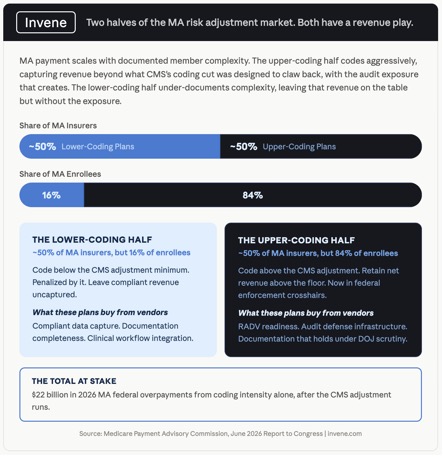
Coding errors don't cancel each other out. They tend to push in one direction or the other, and each direction creates its own kind of problem.
Under-Coding: Revenue Left on the Table
Under-coding happens when a real, documented condition never gets submitted for risk adjustment. Picture a member with diabetes and chronic kidney disease, seen in both primary care and nephrology, where only the office note gets completed and the diagnosis never makes it through a compliant submission workflow. The clinical work happened. The revenue tied to it didn't.
Using the 0.166 diabetes coefficient at the Florida benchmark mentioned earlier, that single missed HCC can mean roughly $2,200 in lost annual revenue for that one member alone. Across a large panel, that adds up fast.
Over-Coding: Audit and Compliance Exposure
The opposite problem is over-coding, submitting conditions that aren't adequately supported by documentation. CMS's MA RADV program exists specifically to verify that submitted diagnoses match the medical record. The stakes here are not small. The HHS Office of Inspector General estimates that roughly 9.5 percent of payments to MA organizations are improper, mainly due to unsupported diagnoses. Get caught with codes that can't be backed up, and a plan can face clawbacks, penalties, and reputational damage.
Coding Accuracy as Revenue and Risk Management
This is the real takeaway for anyone new to the space. Coding accuracy isn't purely an administrative task tucked away in a back office. It's a revenue function, because it determines payment. It's also a risk management function, because errors in either direction create exposure. Treating it as anything less invites problems on both fronts.
How Invene Helps Organizations Improve RAF Performance
The data infrastructure challenge behind accurate, timely coding at scale
Getting RAF right across thousands of members, dozens of providers, and constantly shifting CMS requirements is fundamentally a data problem.
Conditions need to be tracked, recaptured, and submitted accurately and on time every single year.
Across systems that don't always talk to each other.
Final Thoughts
The risk adjustment factor is the financial engine underneath nearly every MA decision, from how a plan prices its annual bid to how a provider group gets paid under a risk-sharing contract. Seeing how RAF connects documentation to dollars makes clear why coding accuracy carries real, lasting urgency for anyone operating in this space.
FAQs
How can Invene help improve RAF accuracy?
Invene builds the data infrastructure that connects eligibility, coding, and submission workflows so MA plans and risk-bearing organizations can catch RAF gaps before they hit revenue. Using Microsoft Fabric, Invene consolidates fragmented systems into one source of truth for tracking, recapturing, and submitting HCCs on time.
Is there a default RAF score for new members?
Not exactly. Members without a full year of Medicare claims history are scored under a separate new enrollee model based on demographics alone. Once diagnosis history builds, they transition to the standard model where documented conditions layer on top.
Is a higher RAF score always better for a health plan?
Generally yes, since higher scores mean higher CMS payments, but only when the score accurately reflects documented, supported conditions. Inflated scores create audit risk rather than sustainable revenue.
Does RAF affect Medicare Advantage members directly?
Not in terms of out of pocket costs, but indirectly yes, since plans with stronger risk adjustment revenue often have more resources to fund benefits and care management programs.
How often does CMS update the HCC model used for RAF?
CMS updates the model periodically rather than on a fixed schedule, incorporating updated clinical and cost data with each revision to keep payments aligned with real member risk.
What's the difference between RAF and STARS ratings?
RAF determines payment based on expected member health complexity. STARS ratings measure care quality and member experience on a one to five scale. Both affect plan revenue, but through entirely separate mechanisms.
Who is responsible for recapturing historical diagnoses each year?
Typically providers, during face to face visits, with support from health plan or risk-bearing organization coding and outreach teams who track which conditions need recapture before the calendar year closes.

James founded Invene with a 20-year plan to build the world's leading partner for healthcare innovation. A Forbes Next 1000 honoree, James specializes in helping mid-market and enterprise healthcare companies build AI-driven solutions with measurable PnL impact. Under his leadership, Invene has worked with 20 of the Fortune 100, achieved 22 FDA clearances, and launched over 400 products for their clients. James is known for driving results at the intersection of technology, healthcare, and business.
Ready to Tackle Your Hardest Data and Product Challenges?
We can accelerate your goals and drive measurable results.