
Automated ETL Process for Healthcare Payer Data Systems

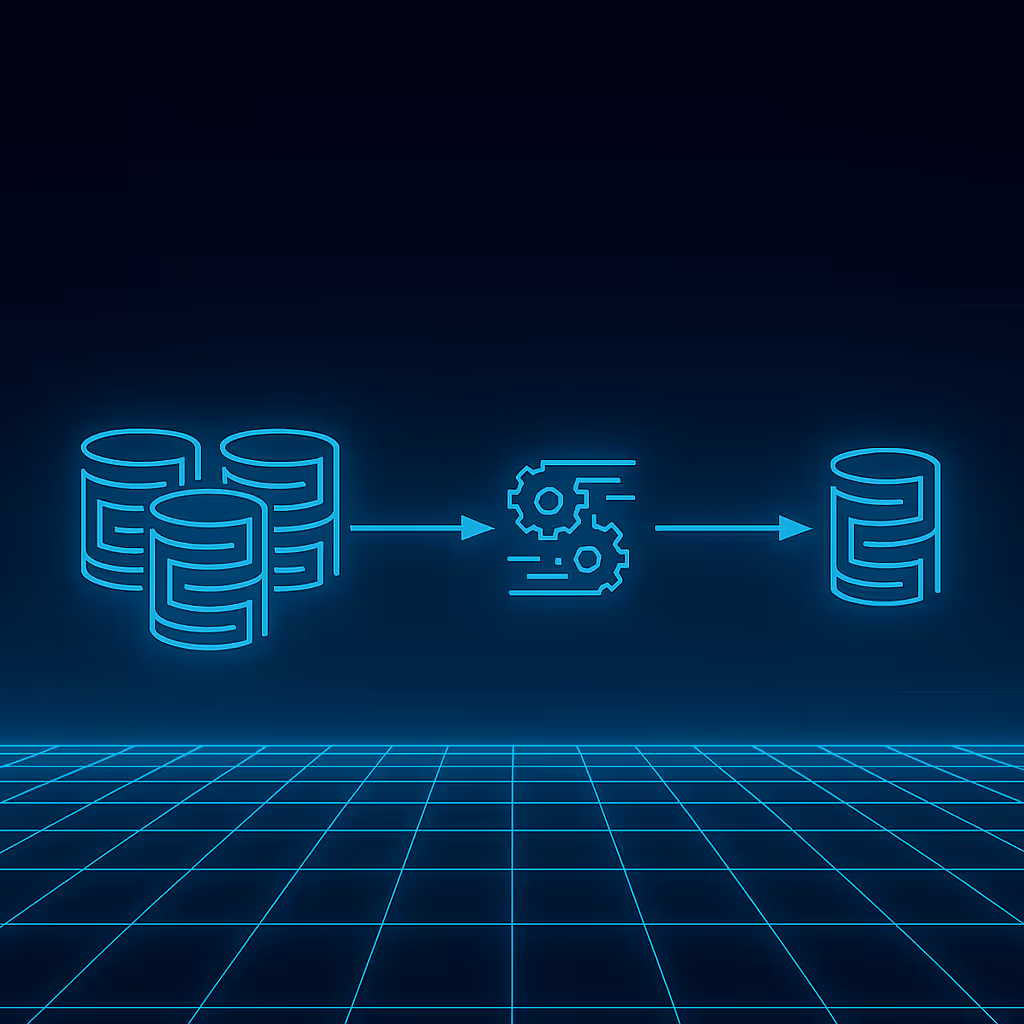
Manual ETL processes create hidden bottlenecks that prevent healthcare organizations from scaling efficiently. When your team spends days processing eligibility files and validating claims data, you're delaying critical business decisions while competitors leverage automation for faster insights.
Healthcare data makes this even harder because each EDI file type, clinical feed, and CMS requirement adds its own validation rules and failure points. This article explains the core architecture of an automated ETL process built for healthcare and how teams can replace manual workflows with reliable, compliance-ready automation.
Healthcare Data Complexity and ETL Automation Challenges
Why Generic ETL Solutions Fail in Healthcare
Healthcare data systems are extraordinarily complex. A typical payer system runs an average of 16 different EHR platforms. Beyond electronic health records, payers and providers must integrate multiple data formats, including HIPAA EDI transaction files like the 834 for enrollment, 837 for claims, and 835 for payment remittance.
The volume creates staggering challenges. About 30% of the world's data is now produced by the healthcare industry, growing at roughly 36% annually. Yet less than 60% of that data is effectively used for decision-making. This gap between data generation and utilization stems from the complexity that generic tools weren't designed to address.
The Financial Cost of Manual Data Processing
Manual data processing in healthcare is extremely costly. The U.S. healthcare system spends about $60 billion annually on nine common administrative transactions. However, 41% of that spending, nearly $25 billion, could be saved by fully automating these workflows, on top of the roughly $187 billion already saved each year by past automation efforts.
Poor data quality carries a huge financial toll. Dirty data costs the U.S. healthcare industry around $300 billion per year, roughly 14% of total healthcare spending. These losses come from duplicated records, incorrect information, and inefficiencies that delay care and inflate operational costs.
Common ETL Pain Points in Healthcare Operations
Healthcare organizations face several predictable pain points:
- Irregular or missing data feeds - Eligibility rosters, claims batches, and CMS files often follow weekly or monthly delivery schedules that are inconsistent across sources.
- File-level failures - Columns shift, row counts are off, or schemas change without notice, requiring anomaly detection to flag missing files or corrupted submissions.
- Rigid formatting rules - EDI files have strict structural requirements, and even minor formatting issues can break an entire workflow.
- Data-level inconsistencies - Demographics do not match across systems, diagnosis codes are outdated, and member identifiers vary by source.
- High data quality demands - ETL pipelines need built-in validation checks, code-set references, and deduplication logic designed for healthcare variation.
- Limited visibility - Teams need real-time dashboards to track expected files, monitor processing status, and identify validation failures quickly, providing full transparency into healthcare data flows.
Architecture Patterns for Healthcare ETL Automation
Building reliable ETL automation for healthcare requires architectural decisions that differ fundamentally from standard business intelligence pipelines.
Incremental vs Full Refresh Strategies
Eligibility data serves as the source of truth for everything downstream. An incremental approach tracks only changes since the last load, preserving history but adding complexity to change data capture logic. This works well for daily eligibility delta files.
Claims processing typically benefits from incremental loads because of the inherent 30 to 60-day claims lag. New claims arrive continuously, adjustments modify historical claims, and reprocessed claims require updates to existing records.
Risk adjustment workflows need access to historical diagnoses for recapture, making hybrid approaches common. You might do full refreshes quarterly while running incremental updates monthly, ensuring you capture both new conditions and historical documentation requirements.
Error Handling and Data Quality Management
Healthcare data arrives with inconsistencies that would crash generic ETL pipelines. Your error handling needs to distinguish between failures that should halt processing and issues that require logging but allow continuation.
Data quality management goes beyond standard null checks. You need to validate NPI to TIN matching to ensure providers are correctly linked to their organizations. You need to check that diagnosis codes are valid for the service date, accounting for the fact that coding standards change annually.
Maintaining data lineage becomes critical for both debugging and compliance. An effective integration architecture tags each record with metadata like source system, file name, and load timestamp while preserving copies of raw inputs in a data lake for audit purposes.
Integration Architecture for Disparate Systems
Healthcare organizations typically connect 15 to 20 different systems in their data ecosystem. Each system speaks a different dialect and operates on a different schedule.
A modern approach uses an integration layer or message bus to decouple sources and targets. A health plan might employ a publish-subscribe model where core systems publish events or files to a central queue, and ETL process subscribers pick them up for transformation. This prevents a spaghetti of one-off point-to-point interfaces.
Your integration architecture needs to handle both batch and real-time data flows. Eligibility might come in monthly batches, while ADT feeds from HIEs arrive in real-time as patients move through the healthcare system.
Healthcare Data Pipeline Implementation Framework
Implementing automated ETL for healthcare requires understanding the specific workflows that drive payer operations.
Eligibility Processing Automation
Eligibility files determine everything in a payer organization. They establish which members are covered, under what plan, and which provider they're attributed to. When eligibility data is wrong, claims get rejected, quality metrics break, and revenue calculations fail.
Health plans often receive enrollment or eligibility files as daily or weekly 834 EDI files. Automating this pipeline means new member additions, terminations, or changes are processed and reflected in downstream systems within hours instead of days.
Weekly or monthly member updates need automated validation that checks for completeness and flags anomalies. If a health plan normally sends 50,000 member records, but this month's file contains only 30,000, your system should detect that discrepancy before loading the data.
Claims Data Integration
Medical claims represent the 837 files that are the lifeblood of healthcare transactions. U.S. payers process roughly 9 billion medical claims each year, making scalability essential. An automated pipeline continuously ingests incoming claim files, applies transformations, and then runs validation rules.
Medical coding validation must happen during ETL, not after. Invalid ICD-10 codes should be flagged immediately, procedures that don't match the diagnosis should trigger alerts, and claim amounts outside expected ranges need investigation.
The relationship between claims and eligibility creates complex join logic. A claim is only valid if the member was eligible on the service date, the provider was in-network, and the service was covered. Your ETL process needs to enforce these business rules automatically.
Risk Adjustment Automation
Risk adjustment directly impacts revenue for Medicare Advantage plans. Historical diagnoses require recapture annually because CMS assumes a condition is resolved unless it's documented again. Your ETL pipeline needs to track which conditions were coded last year and flag them for recapture this year.
According to a report, incorrect medical coding can cause substantial financial losses: recoding reduced total claims from $11,287 to $7,841, meaning errors led to $3,447 in lost payments.
By automating risk adjustment workflows, plans ensure they capture all legitimate diagnoses before submission deadlines. The transition from HCC V24 to V28 coding models demonstrates why healthcare ETL automation requires domain expertise: the same diagnosis code might contribute different risk scores under different models. Your automated pipeline needs to handle both models during the transition period.
Quality Metrics Pipeline
HEDIS measure calculation requires automated pipelines that update annually as measure specifications change. Your ETL automation needs to accommodate these changes without rebuilding the entire pipeline.
Gap-in-care identification depends on integrating data across eligibility, claims, pharmacy, and lab results. A comprehensive diabetes care gap might require checking for an annual eye exam claim, an HbA1c lab result, and a foot exam procedure code.
HIE data requires extensive deduplication because the same hospital admission might be reported by multiple sources. Daily ADT feeds tell you when members are admitted, discharged, or transferred. Your ETL process needs to dedupe these events while preserving timeliness.
Compliance and Regulatory Requirements
Automated ETL processes in healthcare must maintain regulatory compliance while achieving operational efficiency.
HIPAA Compliance and Audit Trails
Every transformation in your automated ETL pipeline needs comprehensive audit logging. HIPAA requires you to document who accessed protected health information, when they accessed it, what they did with it, and why they needed access.
Access controls must operate at the field level, not just the table level. Some users might need access to member demographics but not diagnosis codes. Your ETL architecture should enforce these controls during data loading.
Automation helps avoid compliance slip-ups that result from human error. The average cost of a healthcare data breach has skyrocketed to about $11 million in 2023, the highest of any industry. Automated ETL, when properly secured, reduces risk by limiting manual touchpoints and ensuring consistent security controls.
SOX Compliance
For publicly traded health plans and provider organizations, the Sarbanes-Oxley Act (SOX) requires rigorous internal controls over financial reporting (ICFR). Since risk adjustment payments (RAF scores) are calculated from clinical data and represent significant revenue, the ETL pipeline that processes this data is considered in-scope for SOX audits.
The primary SOX requirement is that financial data must be accurate and tamper-proof. Your automated ETL must enforce data integrity controls to ensure that diagnosis codes (which translate to revenue) are not altered in an unauthorized manner. This demands strict segregation of duties within the ETL environment, ensuring that no single individual can both develop the transformation logic and move the final, financial-impact data into the production environment.
SOX compliance heavily relies on IT General Controls (ITGCs), which govern the IT environment supporting the financial data. These include change management processes for ETL code, robust logical access controls to the data warehouses, and comprehensive data backup and disaster recovery plans. Automation helps maintain these controls consistently, but the system must produce verifiable evidence (logs, reports, sign-offs) that these controls are operating effectively for external auditors.
CMS Submission Requirements
CMS requires specific file formats, validation rules, and timing windows for risk adjustment submissions. Your automated ETL process needs to generate MAO004 files that contain properly formatted ICD-10 codes, valid member identifiers, and accurate service dates.
Timing matters enormously. Miss a deadline for risk adjustment data, and you forfeit revenue for those members. Submit quality measure data late, and you lose the opportunity to improve your STARS rating. Your ETL automation should include scheduling logic that accounts for processing time, validation cycles, and submission windows.
Data Governance Frameworks
Data governance in healthcare balances standardization with flexibility. You need consistent data definitions across your organization while accommodating the reality that different health plans define the same concept differently.
Master data management becomes critical when dealing with provider identifiers. A single physician might have multiple NPI numbers, work for several organizations, and appear differently in various source systems. Your ETL automation needs to resolve these variations into a single golden record while maintaining traceability.
Technology Stack and Platform Considerations
Selecting the right technology stack for healthcare ETL automation requires understanding the trade-offs between different platforms and deployment models.
Cloud vs On-Premise Infrastructure
Healthcare data sovereignty concerns often push organizations toward on-premise deployments, but cloud platforms offer advantages. The elasticity of cloud infrastructure lets you scale processing capacity for month-end loads without maintaining excess capacity year-round. However, healthcare organizations currently store only about 47% of their sensitive data in the cloud, compared to 61% for other industries.
Cloud providers now have strong healthcare offerings with HITRUST certifications. With proper configuration, cloud ETL can be as secure as on-premise while delivering faster innovation. Hybrid architectures split the difference by keeping sensitive data on-premise while using cloud capacity for processing and analytics.
Snowflake vs Databricks Trade-offs
Snowflake excels at structured data warehousing with strong SQL performance and automatic scaling. For healthcare payers dealing primarily with tabular data from eligibility files, claims feeds, and CMS submissions, Snowflake provides a solid foundation. The separation of storage and compute lets you scale each independently.
Databricks brings superior capabilities for unstructured data and machine learning workflows. When you need to parse free-text clinical notes, build predictive models for risk stratification, or process imaging data alongside structured claims, Databricks provides the flexibility.
Most healthcare organizations find they need both capabilities. You might use Snowflake as your enterprise data warehouse for structured operational data while leveraging Databricks for advanced analytics and ML workloads.
Monitoring and Alerting Systems
Healthcare operates on predictable business cycles that your monitoring needs to understand. Eligibility files arrive monthly, claims processing peaks toward the month-end, and CMS submissions have quarterly deadlines. Your alerting system should know that missing an eligibility file on day 3 of the month is more critical than missing it on day 28.
Anomaly detection for healthcare data requires domain knowledge built into the alerts. If a health plan normally sends 50,000 member records, but this month sends 35,000, something is wrong. Your monitoring should establish baselines per data source and alert on meaningful deviations.
Performance and Scalability Engineering
Healthcare ETL pipelines face unique performance challenges that require careful engineering to maintain processing windows and handle volume variability.
Processing Window Requirements
Monthly financial close creates hard deadlines that your ETL automation must meet. When finance needs to close the books by the 5th business day of the month, your pipeline needs to have all prior month claims processed, validated, and loaded.
Real-time eligibility lookups represent the opposite end of the spectrum. When a member calls to verify coverage or a provider checks eligibility before an appointment, they expect an answer in seconds. Your ETL architecture needs to support both batch processing for historical data and real-time queries against the current state.
Volume Variability Management
Claims lag creates unpredictable load patterns. You might receive 10,000 claims one week and 50,000 the next as providers catch up on billing. Seasonal patterns compound this variability, with higher utilization during flu season or at year-end.
Open Enrollment season typically runs from November through January when millions of people enroll or switch health plans. Eligibility and enrollment data surges dramatically, and the ETL system must ingest large files of new members on tight deadlines for coverage effective January 1.
Cloud-native designs with containerized processing and queue-based workload distribution adapt better than monolithic batch jobs. Horizontal scaling strategies work better than vertical scaling. Adding more processing nodes to handle additional health plans scales more predictably than trying to make a single server handle everything.
Scalability Planning for PE-Backed Organizations
Private equity backed healthcare organizations face a distinct challenge that generic ETL systems struggle to handle. When a PE firm acquires three regional health plans in six months, your data infrastructure needs to absorb each acquisition without breaking existing operations.
The integration timeline becomes critical. A typical acquisition gives you 90 to 120 days to onboard the new entity's data systems. During this period, you're simultaneously processing normal business operations while migrating historical claims, reconciling eligibility files from different source systems, and validating that provider networks map correctly across organizations.
Data standardization across acquired entities creates technical debt that compounds quickly. One health plan might use different member ID formats, another might structure their claims data differently, and a third might have unique risk adjustment workflows. Your ETL architecture needs templates and patterns that allow rapid onboarding of new data sources without custom coding each integration.
Growth trajectories in PE-backed organizations typically follow a pattern. Year one focuses on operational improvements within existing entities. Year two brings the first major acquisition. By year three, you might be managing five to seven different health plans, each with their own payer contracts, provider networks, and data formats.
The technical architecture must support this growth path from day one. Building for a single health plan and then trying to retrofit multi-tenant capabilities later creates expensive rewrites and operational risk. Design patterns that separate organization-specific business rules from core processing logic scale better as you add entities. Shared services for data quality, compliance monitoring, and reporting reduce duplicate infrastructure costs.
Testing and validation become exponentially more complex with each acquisition. You need to verify that claims processing for Plan A doesn't accidentally affect member eligibility for Plan B. Automated regression testing and data lineage tracking become essential rather than optional when you're managing multiple concurrent data pipelines across growing organizations.
Business Impact and ROI Analysis
Automating ETL processes in healthcare directly drives significant business value beyond operational efficiency to impact revenue, compliance, and competitive positioning.
Operational Efficiency Gains
The clearest impact is the reduction in manual labor and processing time. Tasks that once required teams of analysts pulling data from multiple systems for days can be done in hours with automation.
For example, automating prior authorizations saves about 14 minutes per transaction for clinical staff. On the health plan side, each manual prior auth costs around $3.41 on average, whereas an automated one costs about $0.05, representing a 98% cost reduction.
According to McKinsey, payers could achieve net savings of 13 to 25% in administrative costs using current AI and automation technologies. In an industry with tight margins, that kind of cost reduction is transformative.
Revenue Optimization
Risk adjustment revenue depends on timely, accurate HCC coding submissions. By automating the capture of diagnosis codes and running algorithms to find missing conditions, health plans can significantly improve their risk scores. Even a few percentage points improvement in risk score accuracy can translate to millions of dollars in additional revenue for a Medicare Advantage plan.
Claims processing speed affects cash flow directly. Reducing claims processing from 14 days to 3 days improves working capital and reduces the need for expensive bridge financing.
Quality measure performance ties directly to STARS ratings, which determine bonus payments from CMS. Automated pipelines that identify gaps in care faster enable earlier member outreach, increasing the likelihood of closing gaps before the measurement period ends.
Final Takeaways
Automated ETL processes are essential infrastructure for competitive healthcare organizations. The complexity of healthcare data, from EDI transactions to CMS compliance, demands purpose-built automation that generic tools cannot handle.
Success depends on workflows tailored to healthcare: eligibility change tracking, lag-aware claims processing, historical risk adjustment recapture, and quality metric pipelines with deduplication and annual updates. The technology stack matters less than domain expertise, whether using Snowflake, Databricks, cloud, or on-premise solutions.
Incremental delivery, strong change management, and measurable ROI ensure implementation success. Organizations that master healthcare ETL automation gain faster decisions, better data quality, and operational leverage, translating into measurable business impact.
Frequently Asked Questions
What makes healthcare ETL automation different from standard business ETL?
Healthcare ETL automation must handle complex data formats (834, 835, 837), strict compliance (HIPAA, CMS), and business rules around eligibility, claims, and risk adjustment.. The timing variability of healthcare data, from monthly eligibility files to real-time ADT feeds, requires architectural patterns that generic tools don't support.
How long does it take to implement automated ETL for a healthcare organization?
A focused implementation automating a few critical data sources typically takes 4 to 6 months for initial deployment, with ongoing expansion as additional sources are onboarded. Organizations with clean data governance, clear business rules, and engaged stakeholders move faster. The key is starting with high-value workflows rather than attempting to automate everything simultaneously.
Should we use Snowflake or Databricks for healthcare data warehousing?
Snowflake excels for structured healthcare data like eligibility files, claims transactions, and CMS submissions with strong SQL performance and automatic scaling. Databricks provides superior capabilities for unstructured clinical data, machine learning applications, and advanced analytics like risk prediction models. Many organizations benefit from both platforms, using Snowflake as the operational data warehouse and Databricks for advanced analytics.
How do we maintain HIPAA compliance in automated ETL processes?
HIPAA compliance requires comprehensive audit logging that captures who accessed data, when, what they did, and why. Your ETL automation needs field-level access controls, encryption for data in transit and at rest, and documentation of every transformation applied to protected health information. Implement role-based access that restricts users to only the data they need and build automated monitoring that detects unusual access patterns.
What ROI should we expect from healthcare ETL automation?
Expect 40–60% savings in staff time spent on manual processing. Revenue improves through faster claims, better risk adjustment capture, and higher STARS ratings. For a 50,000-member Medicare Advantage plan, this can mean $1M–$3M additional annual revenue, with typical payback in 12–18 months.

James founded Invene with a 20-year plan to build the world's leading partner for healthcare innovation. A Forbes Next 1000 honoree, James specializes in helping mid-market and enterprise healthcare companies build AI-driven solutions with measurable PnL impact. Under his leadership, Invene has worked with 20 of the Fortune 100, achieved 22 FDA clearances, and launched over 400 products for their clients. James is known for driving results at the intersection of technology, healthcare, and business.
Ready to Tackle Your Hardest Data and Product Challenges?
We can accelerate your goals and drive measurable results.