
Databricks Bronze Architecture for Multi-Site Provider Organizations: Building a Platform That Survives the Hold Period

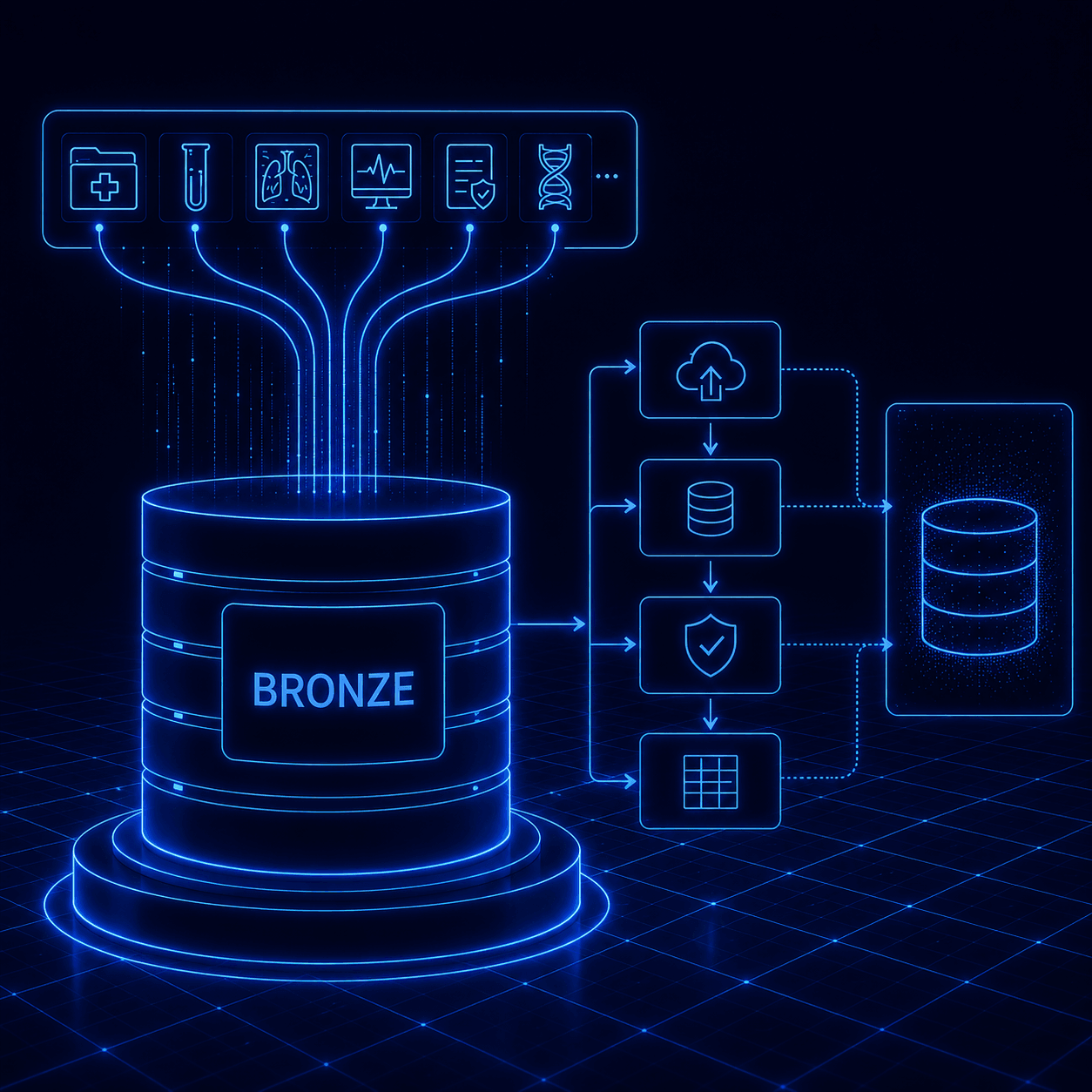
For PE-backed specialty provider groups, every acquisition adds a new EMR, a new data schema, and new compliance obligations to a platform that was never designed to absorb them. This is an issue. The Bronze layer is where that problem either gets solved or permanently deferred. How that layer is designed determines whether the data platform can actually support unified reporting, value-based contract performance, and a credible exit story. In this article, we’ll go over Bronze architecture decisions that matter most for multi-site provider organizations operating under PE ownership.
What Is Actually at Stake When Bronze Design Fails in a Provider Roll-Up
A PE-backed specialty provider group spends twelve months building an enterprise data platform on Databricks. The board wants a unified cost of care report spanning every acquired clinic. The data team pulls the query. It fails. Not because of a bad dashboard. It fails because the fourth acquisition ran a legacy EMR with a different ADT structure, and Bronze was never designed to handle it. That is one of the most common and expensive failure modes in acquisition-driven provider analytics, and it traces back to Bronze layer decisions made long before the second clinic joined the portfolio.
Why PE Sponsors Fund Enterprise Data Platforms and What They Expect to See
PE sponsors fund enterprise data platforms because unified analytics is a direct value creation lever. A provider group that can demonstrate centralized cross-site reporting, operational visibility, and measurable value-based contract performance looks fundamentally different to a buyer than one running disparate EMRs and spreadsheets. The valuation delta is real. A platform that delivers clean portfolio analytics can add meaningful EBITDA multiples at exit and enables operational consolidation centralizing the call center, care management, and population health reporting that is simply not possible without it. People want to buy platforms, not a collection of disconnected systems.
The Specific Failure Mode: Inability to Deliver Unified Analytics Across an Acquisition-Driven Portfolio
The failure is quiet and cumulative, not dramatic. Bronze gets designed for the anchor site's EMR. The first two acquisitions run compatible systems. The third limps through with creative pipeline logic. By the fourth, the schema assumptions baked into Bronze are incompatible with the new source, and the pipeline starts producing incomplete or silently incorrect data. Backfilling requires re-running pipelines against raw data that was never preserved in a format that supports it. The cost of care report the board wants is not just delayed. It is unreliable.
Why Bronze Errors Do Not Surface Until a Value-Based Contract Review or Due Diligence Is Already Underway
Bronze errors are invisible in normal operations. Downstream teams work with Silver and Gold tables. If those tables produce plausible numbers, nobody traces provenance back to Bronze. The discovery comes at the worst possible time: either a payer is questioning cost of care attribution under a risk-sharing arrangement, or a potential acquirer's data team is auditing the platform during buy-side diligence. According to ONC and the AHA, while 71% of U.S. hospitals used standards-based APIs for patient access in 2024, only 35% integrated administrative use cases via standards-based APIs. That interoperability gap means heterogeneous, non-standard data is landing in Bronze at every acquired site and if the layer was not built to handle it, the gap does not stay hidden for long.
Source Data Taxonomy for Provider Bronze Layer Design
Getting Bronze right starts with an honest accounting of what source data actually looks like in a multi-site provider environment. It is a mix of formats, standards versions, and legacy export structures that vary by site and by the EMR each acquired clinic happened to be running.
HL7 v2 Messages: Raw Payload Preservation, MLLP Ingestion, and Why Format Fidelity at Bronze Protects Silver Re-Parsing
HL7 v2 remains the dominant real-time clinical messaging format. ADT, ORU, ORM, and SIU messages flow continuously from EMRs through MLLP connections. Bronze must ingest and store these as raw, unmodified payloads. The temptation to parse at ingestion is real; the raw format is not human-readable. Resist it. Format fidelity at Bronze is what allows Silver to re-parse when segment definitions or field mappings change. If Bronze only stores parsed fields, a correction to parsing logic later has no raw data to run against.
FHIR R4 Resources via Certified EMR FHIR Endpoints and Bulk FHIR APIs
FHIR R4 via certified EMR endpoints is increasingly the preferred integration pattern for larger vendors. JSON ingestion is cleaner than HL7 v2, but it introduces Bronze-level complexity: resource versioning and scope gaps. Not every clinically relevant data element is available through the standard FHIR endpoint without additional configuration. USCDI v3 became the only required USCDI version in the ONC Certification Program as of January 1, 2026, expanding the mandated baseline to include social determinants, diagnostic imaging metadata, and insurance information. Bronze design must account for what is actually available at each site today, not what the standard theoretically permits.
Flat-File EMR Extracts from Legacy or Niche Acquisition-Era Systems
This is where multi-site complexity becomes most acute. Legacy EMRs, the kind a clinic was running before the roll-up, often have no standard integration pathway. Data arrives as CSVs, pipe-delimited files, or custom formats with minimal documentation. Bronze must store these files with schema documentation captured at ingestion time, including field definitions as understood at the time of extract. Without a documented schema locked to each file version, re-parsing after a legacy system upgrade becomes guesswork.
Revenue Cycle Data: 837 Claims and 835 Remittance Files
837 professional and institutional claims files and 835 remittance files carry the financial backbone of the portfolio: what was billed, what was paid, and what was denied. Bronze must store these in their original format without transformation. Denial analysis requires the original 837 alongside the 835 remittance to trace denial reasons back to specific claim lines. Parsing at Bronze destroys the provenance that makes downstream cost of care analytics credible.
Designing Bronze for Multi-Site Onboarding Without Schema Rebuilds
The single-source assumption is the most common Bronze design failure in acquisition-driven environments. The ADT ingestion schema gets built around the anchor site's EMR. It works perfectly for that EMR and breaks quietly for every subsequent one.
The Single-Source Assumption: The Most Common Bronze Design Failure in Acquisition-Driven Environments
Nobody designs a schema that explicitly says "this only works for one EMR." They design one that works for the EMR they have. The assumption that it will generalize never gets tested until the second acquisition, by which time the schema is baked into downstream pipelines. Fixing it requires coordinated updates across Silver and Gold layers that nobody budgeted for.
Source-Agnostic Landing Design: Capturing Raw Payloads with Standardized Ingestion Metadata
The fix is a source-agnostic landing design. The raw payload is stored as a single field, a string or binary column containing the: complete HL7 message, FHIR resource, or flat-file row.
Standardized ingestion metadata:
- Source system ID
- Site ID
- Ingestion timestamp
- Raw format type
This design absorbs any source. The tenth acquisition can bring a previously unseen EMR with a completely different ADT structure, and Bronze ingestion does not break. The site ID and source system ID allow all downstream logic to operate correctly.
Pushing Normalization Burden to Silver So Bronze Can Absorb New Acquisitions Without Upstream Pipeline Disruption
Bronze stores. Silver interprets. Normalization, field mapping, and schema enforcement live at Silver, not Bronze. Adding a new EMR is a Silver-layer problem, not a Bronze-layer rebuild. Databricks explicitly recommends against writing directly from ingestion into Silver because schema changes and corrupt records create cascading failures when there is no preserved raw layer to fall back on.
What Happens When the Tenth Acquisition Brings a New EMR and Bronze Was Not Designed for It
Without source-agnostic design, every new EMR format is a pipeline incident. Engineering time gets spent rebuilding ingestion schemas instead of building analytics. Months of data from the new site may be missing or malformed before anyone detects it. The acquisition that was supposed to expand the platform's value instead creates a data gap that delays portfolio reporting and surfaces during contract reviews or diligence at precisely the wrong moment. Alerting matters here too. Bronze ingestion will break: feed schema changes post-upgrade, interface outages, unexpected file encodings. Configure alerting at the job level and on daily record volume counts. An unexpected drop in ingestion volume is often the first signal of a silent failure.
EMPI Preservation at Bronze and Why It Cannot Be Delegated to Silver
Patient identity resolution across a multi-EMR portfolio is one of the most consequential data problems Bronze design must address, and the one where getting it wrong has the most irreversible downstream consequences.
The Patient Identifier Namespace Problem Across a Multi-EMR Portfolio
Every EMR issues its own patient identifiers. A patient who visited three different clinic sites may have three different medical record numbers, none of which map to each other without external resolution logic. At Bronze, raw source identifiers must be preserved exactly as received, including the source system namespace. Store not just the MRN, but the EMR it came from.
Why Probabilistic EMPI Matching at Silver Requires Bronze to Preserve Raw Source Identifiers Without Transformation
Probabilistic EMPI matching uses demographic similarity, like name, birth date, phone number, and address, to link records across systems. If Bronze normalizes or transforms those fields before storage, the matching logic operates against modified data and confidence scores become unreliable. Matching algorithms improve over time, and when logic is corrected, it needs to re-run against original Bronze data. That re-run is only possible if Bronze preserved the untransformed source record.
Designing Bronze So That EMPI Logic Can Be Rerun Against Original Data Without Data Loss
The design implication is simple: never overwrite or transform demographic fields at Bronze. Store them under tight access controls in their original form, namespaced to the source system, with the ingestion timestamp preserved. When EMPI corrections are required, the engineering team needs a reliable raw foundation to re-run match logic against. Without it, corrections require re-pulling data from source systems that may no longer hold the same records.
Downstream Consequences of EMPI Errors: Care Gap Analytics, Population Health, and VBC Attribution
AHRQ's PSNet has documented that lack of duplicate-record detection capability fragments clinical documentation and can contribute to patient misidentification and treatment delays. In a PE-backed portfolio with value-based contracts, EMPI errors are not a data quality nuisance but a financial risk. A patient split across two identities appears as two patients with incomplete care histories, neither triggering the right interventions. Care gap analytics become unreliable. VBC attribution, which determines which provider receives credit for outcomes, breaks. Population health programs target the wrong members.
Ingestion Pattern Selection by Source Type in a Provider Context
Not all source types warrant the same ingestion pattern. Choosing the right one for each source type is a material Bronze architecture decision, because the wrong choice creates either data freshness problems or unnecessary operational complexity.
Autoloader with Schema Hints Enforced for Batch Flat-File EMR Extracts and EDI File Drops
Databricks Autoloader is the right choice for batch flat-file extracts and EDI file drops. Databricks notes it can discover billions of files efficiently, with discovery cost scaling with files ingested rather than directories scanned. Combined with schema hints that enforce known field structures while allowing files to land without blocking ingestion on minor schema variation, Autoloader gives downstream parsing a consistent target without rejecting files that deviate slightly from expected format.
Structured Streaming for HL7 v2 ADT Feeds Where Admission and Discharge Latency Drives VBC Performance
HL7 v2 ADT feeds require structured streaming. Admission and discharge event latency matters operationally post-acute care coordination and VBC performance metrics both depend on near-real-time awareness of patient movement. Databricks provides end-to-end fault tolerance with exactly-once processing guarantees for supported streaming patterns and recommends designing streaming jobs to expect failure and restart automatically. A batch pattern running every four hours is too slow for the use cases these feeds serve.
Scheduled Databricks Jobs with Incremental Resource Versioning for Certified EMR FHIR Bulk API Endpoints
FHIR Bulk API endpoints are designed for scheduled, incremental pulls, not streaming. Databricks scheduled jobs with incremental resource versioning tracking which resource versions have already been ingested avoid re-ingesting the full resource set on every run while ensuring updates are captured. This is the right pattern for certified endpoints that update on a defined cadence.
USCDI v3 as a Practical Design Input: Mandated Data Elements vs. Those Requiring Custom Configuration
USCDI v3 is useful as a baseline for what can be expected from certified endpoints, but it is a floor, not a ceiling. Many clinically significant data elements are not in USCDI v3 and require custom EMR configuration or a separate interface build to access. Bronze design should explicitly document which elements require additional interface work so that gaps are visible before pipelines are built against their absence.
Connecting Bronze Architecture to the Outcomes PE Sponsors Are Measuring
Bronze is not a technical artifact. It is a financial and operational foundation. Every metric a PE sponsor measures traces back to it.
Unified Operational Reporting and Administrative Cost Reduction as Direct Bronze Architecture Payoffs
A Bronze layer designed for multi-site onboarding enables unified operational reporting without site-by-site data wrangling. That means fewer manual data pulls, fewer reconciliation cycles, and fewer analyst hours cleaning cross-site discrepancies. Call center consolidation, centralized care management, and portfolio-wide scheduling analytics all depend on Bronze absorbing every site's data in a consistent, queryable form. According to CAQH, the healthcare industry has a $20 billion annual savings opportunity from moving administrative workflows to fully electronic processes. A reliable Bronze ingestion layer is the prerequisite for capturing any of it.
Clinical Cost of Care Visibility and Value-Based Contract Performance Measurement from a Credible Data Foundation
Value-based contracts require credible, auditable data. The Medicare Shared Savings Program generated more than $2.1 billion in net savings in 2023, with 480 ACOs participating in 2024. A cost of care report produced from a Bronze layer that silently drops records from two acquired sites is not auditable. A payer challenging attribution under a risk-sharing arrangement will find the gap. A Bronze layer built with format-preserving storage, EMPI preservation, and source-agnostic landing produces a foundation that supports that level of scrutiny.
A Platform Architecture That Absorbs Continued Acquisition Activity Without Data Engineering Debt That Delays the Exit
The hold period is finite. The AMA reports that only 42.2% of physicians worked in private practices in 2024, down from 60.1% in 2012, while 6.5% were in PE-owned practices acquisition activity is not slowing. Every month spent reworking Bronze pipelines for a new site is a month not spent on analytics. The storage cost to support this is manageable: AWS S3 Standard storage runs approximately $0.023 per GB for the first 50 TB per month. On the Databricks side, Lakeflow Spark Declarative Pipelines are priced at $0.20 per DBU at Classic Core, $0.25 at Classic Pro, and $0.36 at Classic Advanced a Bronze estate consuming 5,000 DBUs per month implies roughly $1,000 in software cost at list rate. Compare that to CMS's estimate that manual prior authorization costs providers $34,000 per provider per year in administrative time. A reliable Bronze layer that improves claims and authorization data ingestion is easy to justify against that figure.
Invene's Approach: Designing Bronze as an Operational and Financial Foundation, Not a Staging Layer
At Invene, Bronze design in Databricks Medallion environments is treated as an operational and financial architecture problem. Source-agnostic landing, EMPI preservation, PHI governance across a multi-BAA environment, and ingestion pattern selection by source type are decided before engineering resources are committed to a pipeline that must survive an acquisition-driven portfolio with a defined exit timeline. Getting those decisions right at the start is substantially less expensive than correcting them after the fourth acquisition has already broken something.
Final Thoughts
The Bronze layer is where the promise of a unified provider portfolio analytics platform either holds or quietly collapses. For PE-backed specialty groups operating across multiple clinic sites with fragmented EMR environments, the margin for error is essentially zero. The failures are invisible until they surface at the worst possible moment, and retrofitting a poorly designed Bronze layer costs delayed analytics, unreliable contract performance data, and diligence findings that reframe what should have been a platform story as a technical liability.
Design Bronze for the portfolio you will have at exit, not the one you have today. Every decision source-agnostic landing, preserved raw payloads, Unity Catalog PHI governance, EMPI preservation, and ingestion patterns matched to source latency requirements is reversible before engineering begins. Almost none of them are reversible once the fourth acquisition is live and the pipelines are running.
Frequently Asked Questions
How can Invene help my organization design a Bronze architecture that supports PE-level outcomes?
Invene is a healthcare technology firm that specializes in designing and building data platforms for payers, providers, and life sciences organizations. For PE-backed provider groups, Invene approaches Bronze architecture as an operational and financial decision, not a staging exercise. That means working through source data taxonomy, EMPI preservation, PHI governance across multi-BAA environments, and ingestion pattern selection before any engineering resources are committed to pipelines that must survive an acquisition-driven hold period. If a Bronze layer needs to support unified analytics, value-based contract performance measurement, and a credible exit story, Invene has the clinical and technical depth to design it correctly from the start.
What is the most common mistake made when designing a Bronze layer for a multi-site provider group?
The single-source assumption: designing the Bronze schema around the anchor site's EMR field structure. It works until the next acquisition introduces a different EMR format, at which point the pipeline breaks and the fix requires coordinated updates across Silver and Gold layers that were never budgeted for.
Why can't EMPI resolution just happen at the Silver layer instead of being accounted for at Bronze?
Probabilistic EMPI matching at Silver requires the original, untransformed source identifiers and demographic fields exactly as they existed at ingestion. If Bronze normalizes those fields first, the matching logic operates against modified data. When algorithms improve, re-running them requires raw Bronze records. There is no substitute.
How does PHI governance at Bronze differ in a multi-BAA environment versus a single-site deployment?
A single-site deployment operates under one BAA with uniform terms. A multi-site portfolio has site-specific BAA terms that may impose different data use restrictions. Bronze governance must tag data with its originating BAA at ingestion and enforce access controls per those site-specific terms, not apply a single policy across all sources.
Which ingestion pattern is appropriate for HL7 v2 ADT feeds in a value-based care environment?
Structured streaming. Admission and discharge events drive post-acute care coordination and VBC performance metrics that require low latency. A batch pattern introduces delays that are operationally unacceptable for those use cases.
How does Bronze layer design connect to PE sponsor exit outcomes?
A multi-site-ready Bronze layer absorbs continued acquisitions without accumulating data engineering debt against a finite hold period. It also enables the unified cost of care reporting and VBC performance measurement that PE sponsors need for both operational decisions and the platform narrative that supports a stronger exit multiple.

James founded Invene with a 20-year plan to build the world's leading partner for healthcare innovation. A Forbes Next 1000 honoree, James specializes in helping mid-market and enterprise healthcare companies build AI-driven solutions with measurable PnL impact. Under his leadership, Invene has worked with 20 of the Fortune 100, achieved 22 FDA clearances, and launched over 400 products for their clients. James is known for driving results at the intersection of technology, healthcare, and business.
Ready to Tackle Your Hardest Data and Product Challenges?
We can accelerate your goals and drive measurable results.